How to Choose 3D Printer Filaments: A Comprehensive Guide to Materials and Applications
Selecting the right 3D printer filament is one of the most critical decisions you'll make in your 3D printing journey, as it directly impacts the quality, functionality, and success of your printed objects. With the vast array of materials available on Ibuyem, understanding the characteristics, benefits, and applications of different filaments will help you make informed choices that align with your specific project requirements, skill level, and intended use cases.
1. Best Filaments for Beginners: Starting Your 3D Printing Journey
If you're just beginning your adventure in 3D printing, certain materials will significantly ease your learning curve and help you develop fundamental skills without the frustration of dealing with temperamental or challenging materials. The most recommended and widely used materials for newcomers are PLA (Polylactic Acid) and PETG (Polyethylene Terephthalate Glycol), both of which offer excellent printability and forgiving characteristics that make them ideal for building confidence and experience.
PLA stands as the undisputed champion among beginner-friendly filaments and remains the most commonly used material in the entire 3D printing community. This popularity stems from several key advantages that make it exceptionally user-friendly. PLA prints at relatively low temperatures (typically 190-220°C), requires no heated bed in most cases, produces minimal warping, and emits a pleasant, sweet smell during printing rather than harsh chemical odors. Additionally, PLA is biodegradable, making it an environmentally conscious choice, and it's available in an incredible variety of colors and specialty formulations including silk, metallic, wood-filled, and glow-in-the-dark variants available on Ibuyem.
However, PLA's benefits extend far beyond its beginner-friendly nature. Professional manufacturers, product designers, and engineers frequently choose PLA for rapid prototyping, concept modeling, and tooling applications due to its excellent dimensional accuracy, smooth surface finish, and cost-effectiveness. The material's versatility makes it suitable for everything from decorative items and architectural models to functional prototypes and educational projects.
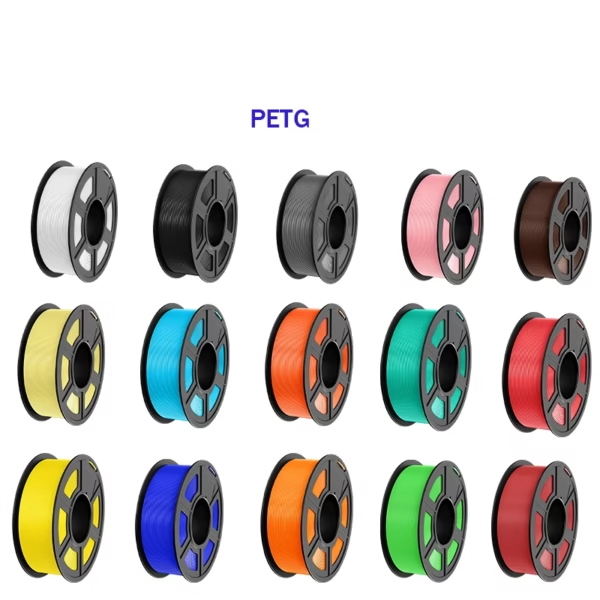
PETG represents another outstanding choice for beginners who want to experience slightly more advanced material properties while maintaining ease of use. This remarkable filament combines the best characteristics of both PLA and ABS, offering the printability of PLA with enhanced strength, chemical resistance, and temperature tolerance approaching that of ABS. PETG prints at moderate temperatures (220-250°C), rarely warps, and produces incredibly strong layer adhesion that results in durable, functional parts. The material is also food-safe when printed with appropriate settings, making it suitable for kitchen accessories and containers. You can achieve excellent results with PETG using BCN3D's Cura standard configuration available through Ibuyem's comprehensive software resources, making it an ideal stepping stone material as you develop your 3D printing expertise.
2. Advanced and Professional Users: Mastering Complex Materials
As your 3D printing skills evolve and your project requirements become more demanding, you'll naturally gravitate toward advanced materials that offer superior mechanical properties, specialized characteristics, and the ability to create more sophisticated, functional objects. The intermediate tier of 3D printing materials includes PP (Polypropylene), ABS (Acrylonitrile Butadiene Styrene), PA (Polyamide/Nylon), and TPU (Thermoplastic Polyurethane), each offering unique benefits for specific applications while requiring more refined printing techniques and environmental controls.
These mid-level filaments open up possibilities for creating more complex designs, functional mechanical parts, and objects that must withstand real-world stresses and environmental conditions. While you can often start with standard profiles available in Cura or other slicing software, achieving optimal results typically requires fine-tuning various parameters including temperature settings, print speeds, cooling configurations, and support structures based on your specific printer setup and environmental conditions.
ABS, long considered the workhorse of professional 3D printing, offers excellent impact resistance, higher temperature tolerance, and superior durability compared to PLA. However, it requires a heated bed, enclosed printing chamber for best results, and proper ventilation due to potentially harmful fumes. PA (Nylon) provides exceptional strength, wear resistance, and chemical compatibility, making it ideal for gears, bearings, and mechanical components, though it requires careful moisture management and high-temperature printing capabilities.
Professional users operating in demanding industrial environments often work with highly specialized materials such as PPGF30 (Polypropylene with 30% Glass Fiber) or PAHT CF15 (Polyamide High Temperature with 15% Carbon Fiber), which represent the pinnacle of 3D printing material technology. These advanced composites offer extraordinary strength-to-weight ratios, exceptional temperature resistance, and professional-grade surface finishes that rival traditional manufacturing methods.
These professional-grade materials require specialized equipment including all-metal hot-ends capable of reaching temperatures exceeding 300°C, hardened steel nozzles to prevent wear from abrasive fibers, enclosed heated chambers for temperature control, and advanced bed adhesion solutions. The investment in both materials and equipment is substantial, but the resulting parts can replace traditionally manufactured components in many applications, offering significant advantages in customization, rapid iteration, and complex geometries that would be impossible or prohibitively expensive using conventional manufacturing methods.
Materials for Prototyping and Tooling: Bridging Design and Manufacturing
One of the most transformative applications of 3D printing lies in its ability to rapidly create prototypes, jigs, fixtures, and specialized tools that facilitate and accelerate the product development and manufacturing process. This application has revolutionized how companies approach product development, allowing for rapid iteration, cost-effective testing, and the creation of custom tooling that would be prohibitively expensive using traditional manufacturing methods.
For general prototyping applications, PLA and PETG continue to be the materials of choice due to their excellent dimensional accuracy, ease of printing, and cost-effectiveness. These materials allow designers and engineers to quickly validate concepts, test fit and function, and communicate design intent to stakeholders without the time and expense associated with traditional prototyping methods. The speed and economy of PLA and PETG make them ideal for iterative design processes where multiple versions of a prototype may be required.
However, when prototypes or tools must withstand more demanding conditions including exposure to chemicals, elevated temperatures, mechanical stress, or repeated use cycles, more advanced materials become necessary. ABS offers excellent impact resistance and temperature tolerance, making it suitable for automotive applications, consumer electronics housings, and tools that will experience moderate mechanical stress. TPU's unique flexibility and durability make it perfect for prototyping gaskets, seals, flexible joints, and products that must absorb impact or flex repeatedly.
For serious tooling applications where durability, precision, and professional appearance are paramount, carbon fiber reinforced materials like PAHT CF15 available through Ibuyem represent the optimal choice. These advanced composites offer exceptional strength, dimensional stability, and resistance to wear, making them suitable for production tooling, assembly fixtures, and end-use parts that must perform reliably over extended periods. The professional appearance and mechanical properties of carbon fiber materials also make them suitable for customer-facing applications and demonstration models.
Commercial Use Needs: Production-Ready Materials for Market Applications
When your 3D printed objects transition from prototypes to commercial products destined for end-users, material selection becomes critical for ensuring product performance, safety, regulatory compliance, and customer satisfaction. Commercial applications demand materials that can consistently deliver the required mechanical properties, aesthetic quality, and long-term durability while meeting relevant industry standards and regulatory requirements.
The transition to commercial production typically necessitates mid-level or professional materials such as PA (Nylon), PAHT CF15, or TPU, each offering specific advantages for different commercial applications. The selection process must consider not only the immediate functional requirements but also long-term performance, environmental factors, regulatory compliance, and manufacturing consistency.
TPU has emerged as a premier choice for commercial applications requiring flexibility, durability, and impact resistance. This remarkable material's elastomeric properties make it ideal for producing phone cases, automotive components, sporting goods, medical devices, and consumer products that must withstand repeated flexing, impact, or compression. TPU's excellent tear resistance and ability to maintain its properties over extended periods make it particularly valuable for products with long service lives or those subject to repeated stress cycles.
For applications requiring a premium aesthetic combined with exceptional mechanical properties, carbon fiber reinforced materials provide an unmatched combination of strength, stiffness, and visual appeal. PAHT CF15 and similar carbon fiber composites available on Ibuyem offer a distinctive, high-tech appearance that conveys quality and sophistication while delivering mechanical properties that often exceed those of traditionally manufactured alternatives. This makes carbon fiber materials ideal for luxury consumer products, professional tools, aerospace components, and applications where both performance and appearance are critical.
The commercial viability of 3D printed products also depends heavily on consistent material quality and reliable supply chains. Ibuyem's extensive network of verified suppliers and rigorous quality control processes ensure that commercial users can access consistent, high-quality materials that meet the demanding requirements of production applications. Our platform's bulk purchasing options, volume discounts, and reliable shipping ensure that commercial users can maintain production schedules while managing costs effectively.
Whether you're developing prototypes, creating custom tools, or producing commercial products, Ibuyem's comprehensive selection of 3D printing filaments, competitive pricing, and expert support resources provide everything you need to achieve success in your 3D printing endeavors. Our platform's detailed product specifications, customer reviews, and technical support ensure that you can make informed material choices that align perfectly with your specific requirements and budget constraints.








 Robot Vacuums
 Steam Cleaner
 Window Robots
 Self Stirring Mugs
 Self Heating Mugs
 Air Purifier
 Dehumidifier
 Diffuser
 Humidifier
 Panoramic Camera
 Solar Camera
 Window Door Sensor
 Baby Monitor
 Small Cameras
 Electric Bike
 Electric Bike Motor
 Electric Scooter
 Electric Skateboard
 Hoverboard

