




Ever felt like your software project is a ship sailing in too many directions at once? You’re not alone. Many development teams struggle with scope creep, feature bloat, and ultimately, a product that doesn’t quite hit the mark. The solution? Radically focusing on specific needs and features. This isn’t about cutting corners; it’s about laser-focusing your energy where it matters most.
This article will guide you through the process of identifying those crucial needs and features, prioritizing them effectively, and building a product that resonates with your target audience. You’ll learn how to avoid common pitfalls, leverage data-driven decision-making, and create a streamlined development process that delivers results. Focusing on specific needs leads to higher customer satisfaction, faster time to market, and better ROI. We’ll explore practical strategies and real-world examples so that you can apply this knowledge to your projects immediately.
Here’s what we’ll cover:
- Understanding the importance of needs-based development
- How to identify and prioritize essential features
- Strategies to avoid scope creep and feature bloat
- The power of user feedback and data-driven decision-making
- Real-world examples and case studies of successful focused development
The Foundation: Needs-Based Software Development
What exactly is needs-based software development, and why is it so crucial? It’s simple: instead of building features for the sake of building features, you start by understanding the core problems and desires of your target users. It’s about shifting from a “build it and they will come” mentality to a “understand their needs, and build the right solution” approach. This ensures your development efforts are aligned with real-world user problems, not just perceived requirements.
Why Prioritize Needs Over Features?
Think of it like this: features are the tools, and needs are the jobs to be done. A feature might be a fancy new reporting dashboard, but the need is to quickly understand key performance indicators (KPIs). If the dashboard doesn’t effectively address that need – if it’s cluttered, confusing, or difficult to navigate – it’s a wasted effort. Focusing on needs ensures that every feature you build serves a clear purpose and delivers tangible value to the user.
Prioritizing needs also leads to a more efficient development process. By focusing on the core problems, you can avoid wasting time and resources on features that are nice-to-have but not essential. This is particularly important for startups and smaller teams with limited resources.
Here are some additional benefits of this approach:
- Increased User Satisfaction: When your software directly addresses user needs, they’re more likely to be satisfied with the product.
- Reduced Development Costs: Focusing on essential features minimizes wasted development efforts.
- Faster Time to Market: A streamlined, needs-focused approach can accelerate your development timeline.
- Improved Product-Market Fit: By aligning your product with actual user needs, you increase its chances of success in the market.
Identifying User Needs: The Key to Success
So, how do you identify those critical user needs? It starts with thorough research and a deep understanding of your target audience. This isn’t about guessing or making assumptions; it’s about gathering data and insights that inform your decisions.
Here are some effective methods for identifying user needs:
- User Interviews: Conduct one-on-one interviews with potential users to understand their pain points, goals, and workflows.
- Surveys: Use online surveys to gather quantitative data from a larger audience.
- User Observation: Observe users in their natural environment as they interact with existing solutions or perform related tasks.
- Analytics Data: Analyze website and app analytics to understand user behavior and identify areas for improvement.
- Customer Support Feedback: Review customer support tickets and feedback forms to identify common issues and pain points.
- Competitive Analysis: Analyze competitor products to identify gaps and opportunities in the market.
Consider a simple example: a project management software team realizes users are struggling to collaborate effectively on documents. Instead of immediately building a complex, feature-rich document editor, they focus on the core need: seamless document sharing and feedback. They might start with simple integrations with existing document platforms like Google Docs and Microsoft Word, allowing users to easily share and comment on documents within the project management tool. This focused approach allows them to address the user’s core need quickly and efficiently.
Prioritizing Features: The Art of Saying “No”
Once you’ve identified a list of potential features based on user needs, the next step is to prioritize them. Not all features are created equal, and it’s crucial to focus on the ones that will deliver the most value to your users and align with your business goals. This stage is where the power of focusing on specific needs truly shines, as it will greatly aid in deciding what makes the cut and what must be put on the backlog.
The Importance of Feature Prioritization
Why is feature prioritization so important? Because resources are always limited. You can’t build everything at once, and trying to do so will only lead to a diluted product, a stressed-out team, and a delayed launch. Effective feature prioritization allows you to focus your efforts on the features that will have the biggest impact, ensuring that you deliver a valuable product quickly and efficiently.
It also helps to manage stakeholder expectations. By clearly communicating your prioritization criteria and rationale, you can avoid conflicts and ensure that everyone is aligned on the product vision. Focusing on specific needs means that less important elements will be seen as lower priority, something stakeholders will understand.
Prioritization Frameworks: Tools for Decision-Making
There are several frameworks you can use to prioritize features, each with its own strengths and weaknesses. Here are a few popular options:
- RICE Scoring: RICE stands for Reach, Impact, Confidence, and Effort. You assign a score to each feature based on these four factors, and then calculate a total score to rank the features. This is a very powerful tool for any project, and focusing on specific needs will help greatly in assigning scores, since the impact will be greater and the reach will be more effective.
- MoSCoW Method: MoSCoW stands for Must have, Should have, Could have, and Won’t have. You categorize features into these four categories based on their importance. This is a simple and intuitive method that’s easy to understand and implement.
- Kano Model: The Kano model categorizes features based on how they affect customer satisfaction. Features are classified as basic, performance, or delighters. This model helps you understand which features will have the biggest impact on customer loyalty.
- Value vs. Effort Matrix: This simple matrix plots features based on their value to the user and the effort required to implement them. You prioritize features that offer high value and require low effort.
Regardless of the framework you choose, it’s important to involve key stakeholders in the prioritization process. This ensures that everyone’s voice is heard and that the final decisions are well-informed. When discussing features, always ask how each of them will fulfill specific needs of the product’s target audience. If the feature doesn’t clearly fulfill any need, then it should be considered of lower priority.
Let’s say you’re building a new e-commerce platform. You’ve identified several potential features, including a customer loyalty program, a product recommendation engine, and a mobile app. Using the RICE scoring model, you might assign higher scores to the product recommendation engine (high reach, high impact) and the mobile app (high reach, moderate impact), while assigning a lower score to the customer loyalty program (moderate reach, moderate impact). This would help you prioritize the product recommendation engine and the mobile app over the customer loyalty program.
Combating Scope Creep and Feature Bloat
Scope creep and feature bloat are the enemies of focused development. They can derail your project, drain your resources, and ultimately lead to a product that’s bloated, confusing, and doesn’t meet the needs of your users. These can be mitigated by emphasizing focusing on specific needs.
Understanding the Dangers
Scope creep refers to the uncontrolled expansion of a project’s scope after it has already begun. This can happen when new features are added without proper planning, analysis, or prioritization. Feature bloat, on the other hand, refers to the excessive addition of features to a product, often without a clear understanding of their value or impact. This can lead to a product that’s overly complex, difficult to use, and ultimately fails to meet the needs of its users.
Both scope creep and feature bloat can have serious consequences, including:
- Increased Development Costs: Adding new features increases development costs and can strain your budget.
- Delayed Launch: Scope creep and feature bloat can significantly delay your product’s launch.
- Reduced User Satisfaction: A bloated, complex product can be frustrating and difficult to use, leading to reduced user satisfaction.
- Decreased ROI: When you’re spending more time and money on a product that’s not meeting the needs of its users, your ROI will suffer.
Strategies for Prevention
So, how do you prevent scope creep and feature bloat? It starts with a clear understanding of your product vision and a disciplined approach to feature management.
- Define a Clear Product Vision: Start by defining a clear and concise product vision that outlines the core purpose and goals of your product. This will serve as a guiding light for all your development decisions.
- Establish a Rigorous Change Management Process: Implement a formal change management process for evaluating and approving new feature requests. This process should include a thorough analysis of the feature’s value, impact, and feasibility.
- Prioritize ruthlessly: Continuously evaluate and prioritize features based on their value and impact. Be willing to say “no” to features that don’t align with your product vision or that offer limited value.
- Embrace Agile Development: Agile development methodologies, such as Scrum, are designed to be flexible and adaptable. This allows you to respond to changing user needs while minimizing the risk of scope creep.
- Focus on Minimum Viable Product (MVP): Start by building a minimum viable product (MVP) that includes only the essential features needed to solve the core user problem. This allows you to get your product to market quickly and gather feedback from real users.
- Regularly Review and Refine: Continuously review your product roadmap and backlog to identify and remove features that are no longer relevant or that are not delivering the expected value.
Imagine you’re building a CRM system. A sales rep suggests adding a feature to automatically generate personalized birthday cards for clients. While it sounds nice, it’s not core to the CRM’s primary functions (managing contacts, tracking sales, reporting). By sticking to the core product vision and rigorously evaluating new requests, you can avoid adding unnecessary features and keep your project on track. Remember, it all revolves around focusing on specific needs of the target audience and what they need most.
The Power of User Feedback and Data-Driven Decisions
User feedback and data are your most valuable assets in the quest to build a successful product. They provide insights into how users are actually using your product, what they like, what they don’t like, and where there’s room for improvement. Using this information is a very important element of focusing on specific needs.
Why Listen to Your Users?
Why is user feedback so important? Because it allows you to validate your assumptions, identify unmet needs, and build a product that truly resonates with your target audience. Ignoring user feedback is like driving blindfolded – you’re bound to crash eventually. The best way to make the product address specific needs is to learn about those needs from the users themselves.
Collecting and analyzing user feedback is an ongoing process, not a one-time event. It should be integrated into every stage of the product development lifecycle, from initial concept to post-launch maintenance.
Methods for Gathering Feedback
There are numerous methods for gathering user feedback, each with its own advantages and disadvantages. Here are a few popular options:
- In-App Surveys: Use in-app surveys to gather feedback from users while they’re actively using your product.
- User Testing: Conduct user testing sessions to observe how users interact with your product and identify usability issues.
- Feedback Forms: Provide users with a feedback form to submit their comments, suggestions, and bug reports.
- Social Media Monitoring: Monitor social media channels for mentions of your product and respond to user comments and questions.
- Analytics Data: Analyze website and app analytics to understand user behavior and identify areas for improvement.
- A/B Testing: Use A/B testing to compare different versions of a feature and determine which one performs best.
Turning Data into Actionable Insights
Gathering user feedback is only half the battle. You also need to analyze the data and turn it into actionable insights. This involves identifying patterns, trends, and key themes in the feedback and using that information to inform your product development decisions.
For example, let’s say you’re building a mobile app. You notice that a large number of users are dropping off at a particular step in the onboarding process. This suggests that there’s a usability issue at that step. You might then conduct user testing to identify the specific problem and make changes to the onboarding flow to improve the user experience. If it is revealed through user data that the onboarding process isn’t addressing specific needs of a potential user, then that needs to be fixed ASAP.
Remember, data-driven decisions are not about blindly following the numbers. It’s about using data to inform your intuition and make more informed decisions. It’s also crucial to consider qualitative feedback alongside quantitative data to gain a more complete understanding of the user experience.
Real-World Examples: Success Stories of Focused Development
To illustrate the power of focused development, let’s look at a few real-world examples of companies that have successfully implemented this approach.
Case Study 1: Basecamp
Basecamp, a popular project management tool, is known for its minimalist design and its focus on essential features. The company has resisted the urge to add every feature requested by its users, instead opting to focus on the core functionality that its users rely on every day. This has allowed Basecamp to maintain a clean, intuitive user experience and avoid the feature bloat that plagues many other project management tools. This is because they know that focusing on specific needs for project management, and not other categories, is what their users like most.
Case Study 2: Dropbox
Dropbox started as a simple file-sharing service and has gradually expanded its feature set over time. However, the company has always remained focused on its core mission: making it easy for users to access and share their files from anywhere. This has allowed Dropbox to maintain a strong brand identity and avoid the pitfalls of trying to be everything to everyone.
Case Study 3: Tesla
Tesla initially focused on building high-performance electric sports cars before expanding into more affordable sedans and SUVs. This allowed the company to build brand awareness and establish its credibility in the electric vehicle market before tackling the mass market. Tesla’s success is, in part, due to focusing on specific needs for its initial customers. They knew that if they satisfied the requirements for that target audience, then scaling upwards would be a piece of cake.
These examples demonstrate that focusing on specific needs and features can lead to success in a variety of industries. By understanding your target audience, prioritizing your efforts, and staying true to your product vision, you can build a product that truly resonates with your users and achieves your business goals.
Conclusion: Embrace the Power of Focus
In conclusion, focusing on specific needs and features is a critical strategy for building successful software products. By understanding your target audience, prioritizing your efforts, and avoiding scope creep and feature bloat, you can deliver a valuable product that meets the needs of your users and achieves your business goals. Remember that focusing on specific needs helps create a project that caters to the core requirements of the target audience, leading to greater product adoption and overall user satisfaction. It will also help in creating a much more agile and efficient workflow, since you can concentrate your efforts on fewer elements.
So, embrace the power of focus and start building products that truly make a difference.
Next Steps
- Start by conducting user research to identify the core needs of your target audience.
- Use a prioritization framework to prioritize features based on their value and impact.
- Implement a change management process to prevent scope creep.
- Gather user feedback and data to inform your product development decisions.
- Continuously review and refine your product roadmap to ensure that you’re staying focused on the most important features.
FAQ
What is needs-based software development?
Needs-based software development focuses on identifying and addressing the core problems and desires of your target users. Instead of building features for the sake of it, you prioritize features that directly solve user problems and deliver tangible value.
How do I identify user needs?
You can identify user needs through various methods such as user interviews, surveys, user observation, analytics data, customer support feedback, and competitive analysis. These methods help you gather data and insights to understand user pain points and goals.
What are some common feature prioritization frameworks?
Popular feature prioritization frameworks include RICE scoring (Reach, Impact, Confidence, Effort), MoSCoW method (Must have, Should have, Could have, Won’t have), Kano model, and the Value vs. Effort Matrix. These frameworks help you objectively rank features based on their importance and feasibility.
How can I prevent scope creep and feature bloat?
Prevent scope creep and feature bloat by defining a clear product vision, establishing a rigorous change management process, prioritizing ruthlessly, embracing agile development, focusing on a Minimum Viable Product (MVP), and regularly reviewing and refining your product roadmap.
Why is user feedback important?
User feedback allows you to validate your assumptions, identify unmet needs, and build a product that truly resonates with your target audience. It provides insights into how users are interacting with your product and where there is room for improvement.
What is RICE scoring and how does it help prioritize features?
RICE scoring is a prioritization framework where you score each feature based on its Reach (how many users will be affected), Impact (how much will it impact users), Confidence (your confidence level in your estimates), and Effort (how much effort is required). A RICE score is then calculated to rank and prioritize the features.
Content Disclaimer
Information provided in this article is for educational purposes only and should not be considered professional advice. Always consult with qualified professionals for specific guidance related to your situation. Results may vary based on individual circumstances.
Categories
- 3D Printer (517)
- Automatic Mugs (426)
- Cleaning Appliances (504)
- Electric Bikes (214)
- Electric Scooters (456)
- Electronic Gadgets (183)
Archives
About Team Ibuyem
View all posts by Team IbuyemProduct Gallery
-
Meian Smart Home Doorbell Wireless Security Doorbell IP65 Waterproof Outdoor Door Bell 60 Songs 5 Volume Adjustable Chime Kit
Rated 4.79 out of 5$14.00 – $30.00Price range: $14.00 through $30.00
-
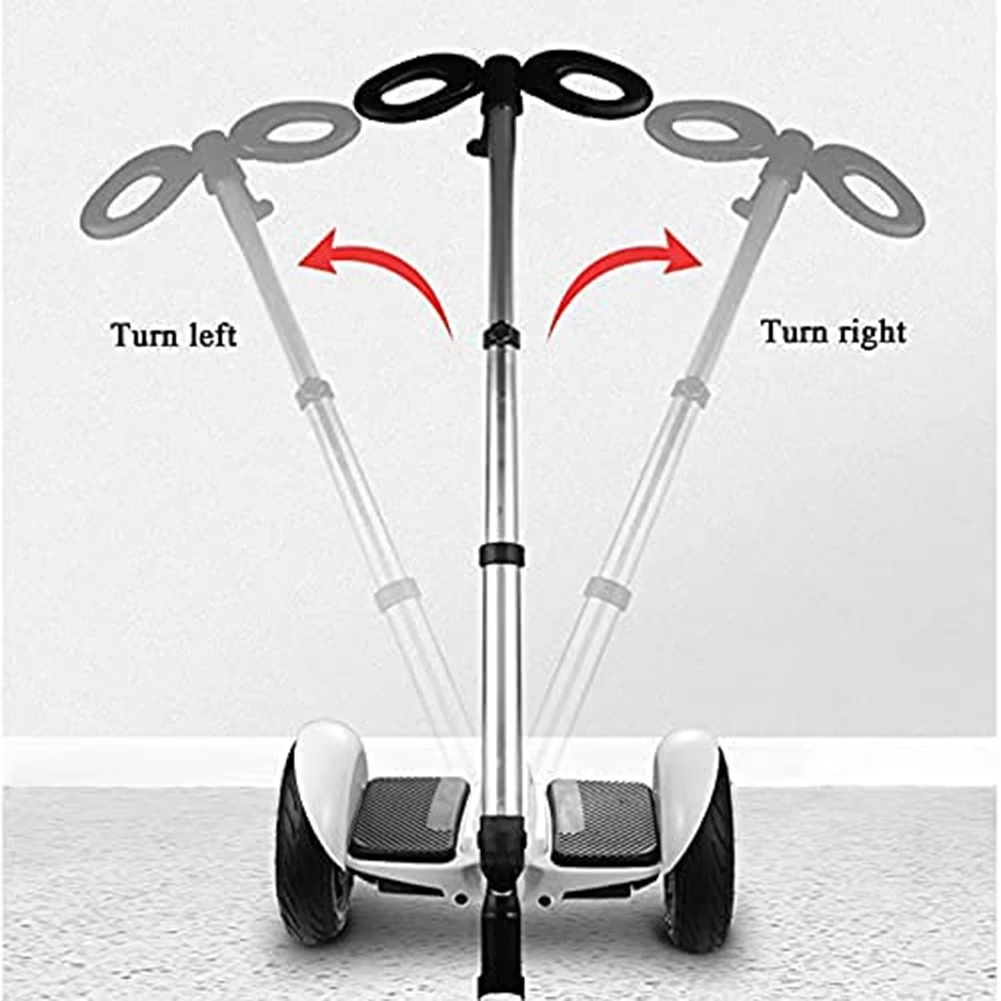 ABHS-Handlebar Suitable For Segway Ninebot Minipro Minilite Hoverboard Adjustable Three-In-One Function Pressure Handle
$57.00
ABHS-Handlebar Suitable For Segway Ninebot Minipro Minilite Hoverboard Adjustable Three-In-One Function Pressure Handle
$57.00
-
 Modern Fashion 2 Wheel Smart Aluminum Hooverboard Self Balancing Scooter Kids Adults Electric Balance Scoter
$348.00
Modern Fashion 2 Wheel Smart Aluminum Hooverboard Self Balancing Scooter Kids Adults Electric Balance Scoter
$348.00


 Robot Vacuums
 Steam Cleaner
 Window Robots
 Self Stirring Mugs
 Self Heating Mugs
 Air Purifier
 Dehumidifier
 Diffuser
 Humidifier
 Panoramic Camera
 Solar Camera
 Window Door Sensor
 Baby Monitor
 Small Cameras
 Electric Bike
 Electric Bike Motor
 Electric Scooter
 Electric Skateboard
 Hoverboard
 3D Printers
 3D Printer Filament

Recent Comments